
LockScore Release
TL;DR: I created LockScore, a modern tool that accurately measures password strength in a user-friendly way to replace outdated and frustrating password rules.
Traditional password creation rules—such as requiring complex combinations of uppercase and lowercase letters, numbers, special characters, and frequent password changes—have long been considered essential for security. However, these rules often prove frustrating and counterproductive for users, ultimately undermining their intended purpose.
The Drawbacks of Traditional Password Rules
User Frustration and Memorability Issues Complexity requirements make passwords difficult to remember. Users frequently struggle to comply with strict rules, leading to frustration and increased cognitive load. This often results in insecure workarounds such as writing passwords down, storing them insecurely, or relying on password recovery mechanisms more frequently.
Predictable and Reused Passwords Ironically, complexity rules can encourage predictable password patterns—like capitalizing the first letter, appending “1!” or substituting characters with common replacements (e.g., “P@ssw0rd”)—which attackers can easily guess. Because complex passwords are hard to remember, users tend to reuse them across multiple accounts, increasing vulnerability to credential stuffing attacks.
Limited Security Benefits and Increased Risks While complexity theoretically increases the number of possible password combinations, in practice, the security gains diminish beyond a certain point. Attackers exploit common user behaviors induced by complexity rules, making passwords easier to guess than intended. Frequent forced password changes also lead to weaker passwords or predictable incremental changes, which do not improve security but increase user burden.
Higher Support Costs and User Resistance Complex password policies cause more sign-in failures and password reset requests, leading to higher operational costs and user dissatisfaction.
Expert Critiques and Modern Recommendations
Leading authorities like the National Institute of Standards and Technology (NIST) and Microsoft have revised their guidance, questioning the effectiveness of traditional complexity rules. NIST’s Special Publication 800-63-3 now recommends against mandatory special characters and frequent password changes, emphasizing longer passwords and user-friendly policies instead. Microsoft similarly advocates for policies that balance security with usability, recognizing that overly complex rules can increase security risks rather than reduce them.
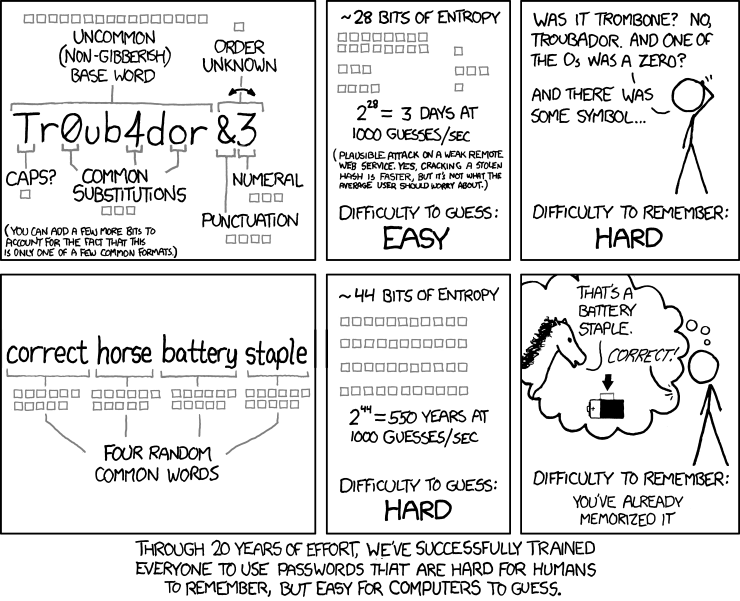
This shift echoes the message popularized by the xkcd comic on password strength, which humorously illustrates that a longer passphrase made of common words (e.g., “correct horse battery staple”) can be both easier to remember and more secure than a short, complex password filled with random symbols. This insight highlights the importance of password length and memorability over arbitrary complexity.
xkcd.com is best viewed with Netscape Navigator 4.0 or below on a Pentium 3±1 emulated in Javascript on an Apple IIGS at a screen resolution of 1024x1. Please enable your ad blockers, disable high-heat drying, and remove your device from Airplane Mode and set it to Boat Mode. For security reasons, please leave caps lock on while browsing.
Introducing LockScore: A Modern Alternative
In light of these challenges, LockScore offers a modern, user-friendly approach to password security. Instead of enforcing rigid complexity rules, LockScore measures password strength more accurately by evaluating actual resistance to attacks, considering length, unpredictability, and user behavior.
LockScore empowers users to create passwords that are both secure and memorable, reducing frustration and the tendency to reuse passwords. By replacing outdated password policies with LockScore’s nuanced strength assessment, organizations can improve security while enhancing usability.
In conclusion, traditional password creation rules often frustrate users and lead to insecure practices, undermining their security goals. Expert critiques and updated guidelines from authorities like NIST and Microsoft highlight the need for more effective, user-centered approaches. LockScore embodies this modern philosophy, offering a practical alternative that improves both security and user experience, aligned with insights from the xkcd password strength meme and contemporary cybersecurity research.